Tuesday TEDMEDLive 2012 and its artifacts

What a great start to TEDMED2012.

Tuesday’s session had Traces, Bryan Stevenson, Teresa Monachino, Rebecca Onie, Jill Sobule, WPAS Children of the Gospel Choir, and Step Afrika! All packed into 2 hours.

Instead of repeating what was tweeted, I’d invite you to look at the uthscfrc Twitter feed at http://twitter.com/#!/uthscfrc

Great Talks has compiled some of the best posts from Tuesday’s session and UTHSC is mentioned – find it here http://paper.li/sansfront/1294843801#!tag-tedmed

Make sure you have a look at what Alphachimp is doing in scribing TEDMED – find that here http://www.alphachimp.com/weblog/2012/4/10/tedmedlive.html

If you want to see ALL tweets related to TEDMED, go here http://twitter.com/#tedmed

One of the most re-tweeted tweets of yesterday was from uthscfrc (us) – it was a quote from Bryan Stevenson’s talk

if you’re a doctor you can do amazing things, if you’re a compassionate doctor you can do phenomenal things

Join your colleagues at TEDMED here at UTHSC at the General Education Building, Room A103!

The Great Challenges of Health and Medicine

If you drew up your list of great challenges, what would be on it?

  • Managing Chronic Diseases.
  • The Impact of Poverty on Health.
  • Eliminating Medical Errors.
  • Unwed Teen Motherhood.
  • Elevating Dental Health.
  • Medical Information Overload.
  • Something else?

The diverse gathering of TEDMED attendees – onsite and at simulcast locations such as UTHSC – will be participating in The Great Challenges Program. The idea is to provide America and the world with a comprehensive view of the great challenges.

A proposed list of 50 great challenges of health and medicine have been drawn up [download full brochure here]. During TEDMED, 50 knowledgeable individuals will serve as Advocates for those 50 challenges. The Advocates will circulate among the 1200 onsite attendees and be able to interact with simulcast participants via the TEDMED Connect application.

The 20 final Great Challenges will be decided by a vote – and your vote, as a TEDMED attendee, will count!

In the coming year, multiple strategies will be used continue the dialogue on the selected 20 Great Challenges.

  • Interviewing the Advocates of the Challenge for their thoughts – leading to a series of TV program style segments called Perspectives
  • TEDMED community members will be able to post their thoughts and feedback to each perspective
  • TEDMED will host 40 webinars during the coming year (2 per Great Challenge) that consist of roundtable panel discussions featuring 4 to 6 qualified individuals engaging in multi-disciplinary dialogue.

Want to know if the issues on your list of Great Challenges is among the top 50? Visit TEDMED’s Great Challenges Program website!

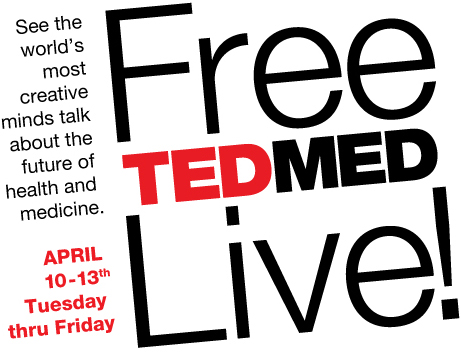
TEDMEDLive 2012 @ UTHSC

IMPORTANT! Stay up to date with the TEDMED schedule and interface directly with presenters and the on-site audience by downloading the TEDMED Connect application for iPhones, iPads, and Androids (I can’t locate the app for Androids right now – check the Android app store).

UTHSC is in great company for TEDMEDLive. Check out the map of participating institutions who’ve signed up to receive the TEDMED simulcast.

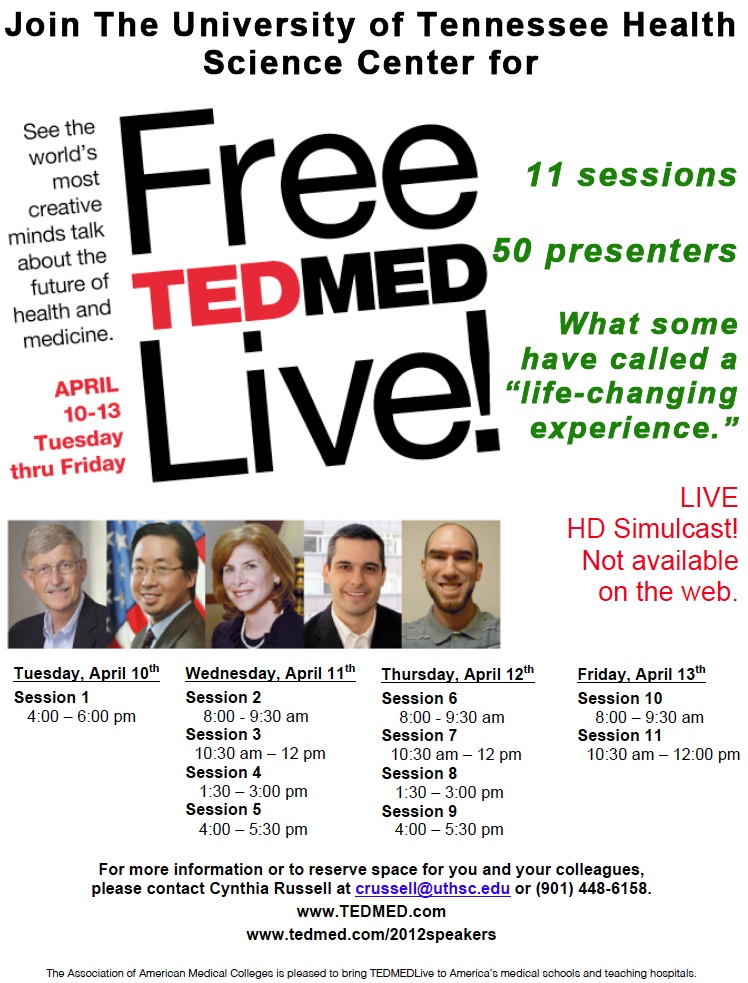
Sessions at UTHSC are scheduled as follows:

  • Tuesday, April 10. Session 1. 4pm to 6pm. Pharmacy 101.
  • Wednesday, April 11 and Thursday, April 12. Sessions 2 through 9. 7:45am to 5:30pm. General Education Building A102.
  • Friday, April 13. Session 10 and 11. 7:45am to 12pm. General Education Building A102.

Individuals from the Memphis health care community, medical device manufacturing community, University of Memphis, and others will be joining UTHSC faculty, staff, and students for one or more sessions.

Plan to join your colleagues for an event that will challenge and change your thinking, stimulate innovation and imagination, and inspire us to think about the possibilities in health and medicine. Bring a friend!

RSVP right away if you’re attending the Tuesday evening session so we can plan for beverages/snacks – faculty and staff can go to the HR Training website and select the TEDMED event in the right-hand column. Students, email crussell@uthsc.edu if you plan to attend.

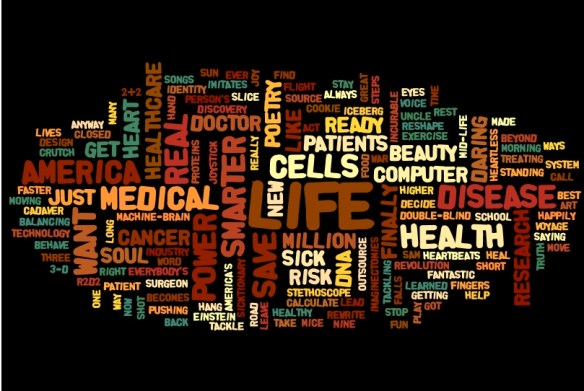
Wordle me a TEDMED talk

Check out this word cloud (Wordle) of the titles of the talks scheduled for TEDMEDLive 2012. This was done by Jonathan Eisen who, on his blog, lists himself as an evolutionary biologist, microbiologist & genomicist, Open Science advocate, recovering Harvard/Stanford alum, cyclist & Professor at UC Davis. Check out his blog for links to his lab page, Google Profile, and Twitter feed.

Eisen is presenting at TEDMED 2012 – the title of his talk is Who are “Me, Myself, and Us?”

People who will truly innovate are those who have no fear…

… so said Peter Diamandis in his TEDMED 2011 talk (watch it below). He talks about how innovation will increase exponentially thanks to cheaper and more easily available technology. Having a common goal, an enticing motive, and being fearless helps.

Diamandis is the founder of X PRIZE and the co-author of Abundance: The Future is Better than you Think. The mission of the X PRIZE Foundation is to bring about radical breakthroughs for the benefit of humanity by motivating and inspiring brilliant innovators from all disciplines to leverage their intellectual and financial capital.

Who will innovate? Who HAS innovated?

  • James Watson – 25 when he co-published his breakthrough scientific paper on DNA
  • Albert Einstein – 26 when he published the Special Theory of Relativity
  • Jonas Salk – 30 when the March of Dimes funded his polio research
  • Isaac Newton – 23 when he began inventing calculus
  • Marie Curie – 30 when she began investigating radioactivity; by age 45 had earned two Nobel Prizes
  • Galileo – 22 when he published his first piece
  • William Lawrence Bragg – 25 when he received a Nobel Prize in physics

The young do not know enough to be prudent, and therefore they attempt the impossible … and achieve it, generation after generation. Pearl S. Buck, First Woman to receive the Nobel Prize in Literature

If the above is true, why is it that NIH funding increasingly goes to older researchers?

In 2007, more grants were given to 70-year-old researchers than those under age 30.

The people who will truly innovate are those who have no fear.

What about you? Fearless?


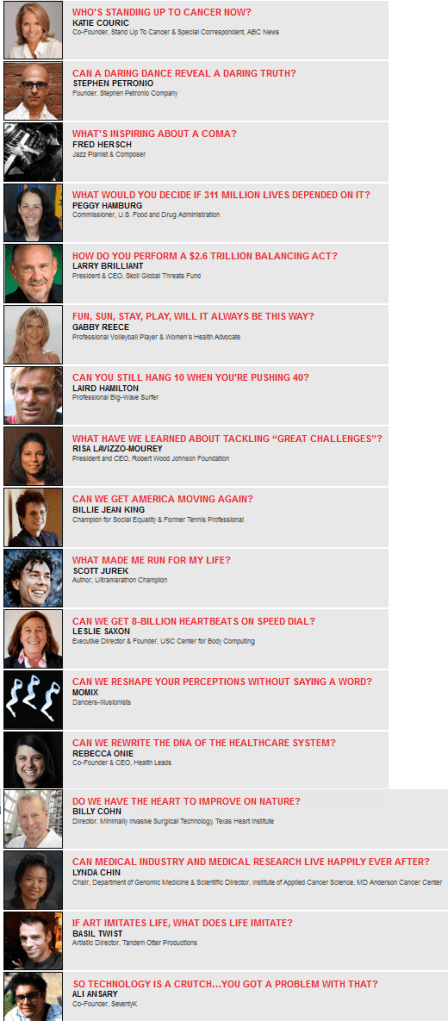
New Speakers Announced for TEDMEDLive

New speakers. New twists on what we think we know about healthcare and our healthcare challenges.

  • Katie Couric on cancer.
  • Billie Jean King on getting America moving.
  • Momix dancers/illusionists on reshaping our perceptions. IXperience the IXceptional!
  • Leslie Saxon of the USC Center for Body Computing on whether we can get 8-billion heartbeats on speed dial.
  • And many more.

Have a look. TEDMEDLive @ UTHSC is going to be great!

TEDMED’s Great Challenges Program

What are the Great Challenges of health and medicine, asks Jay Walker, the curator of TEDMED. While there are hundreds, TEDMED has worked with leading health institutes, think tanks, foundations, and individual experts to identify 50 of the most pressing Great Challenges.

With the sponsorship of the Robert Wood Johnson Foundation, TEDMED is hosting the Great Challenges Program

because our community is dedicated to sharing cutting-edge ideas and unusual perspectives. TEDMED believes that before America can effectively address its most complex and persistent health issues, we need a broader, richer understanding of these Challenges. Accordingly, the mission of the Great Challenges Program is not to “solve” America’s most confounding health and wellness problems. Instead we seek to provide America and the world with a comprehensive view, incorporating multiple perspectives, that can set the stage for truly effective action.

Delegates and attendees at the local site for TEDMED (The Kennedy Center) as well as those at the remote simulcast sites (like The University of Tennessee Health Science Center), will be able to learn about the 50 proposed Great Challenges and vote for the 20 final Great Challenges.

What is an example of a Great Challenge? Let’s look at Great Challenge #13: Setting R&D Priorities and Allocating Resources. From the TEDMED Great Challenges Overview:

Churchill described democracy as “the worst form of government, except for all the others.” Our current system of allocating government funds for medical R&D priorities is strongly influenced by political factors at times, and is constantly criticized from all sides. Are there better systems to rank medical R&D priorities and if so, what are they and how can they be integrated into America’s public allocation system?

Visit TEDMED’s Great Challenges website to read more about these challenges and to download an overview of the top 50 Great Challenges.

What’s YOUR idea of a Great Challenge of health and medicine?