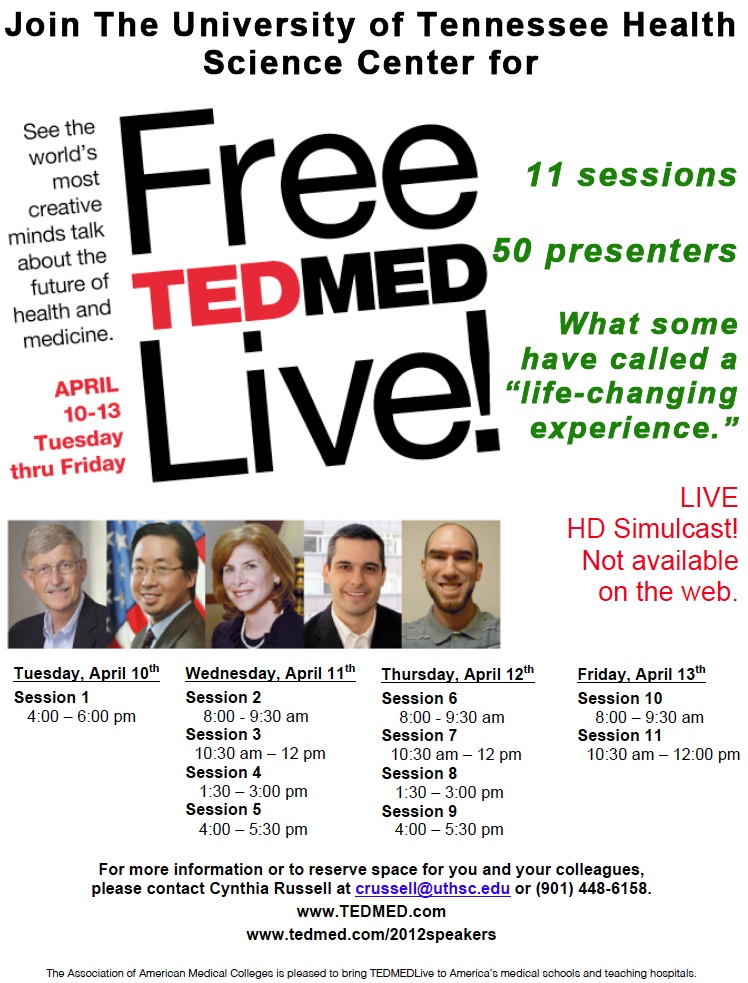
TEDMEDLive 2012 Schedule
Reply
Answer: They’re the 5 latest speakers added to the TEDMEDLive 2012 lineup.
Join us at The University of Tennessee Health Science Center on Tuesday April 10 through Friday April 13 as we pull down the HD Simulcast of TEDMEDLive.


As the 2nd webinar in Data Privacy Month, this EDUCAUSE webinar focused on Privacy and Security Risks in Higher Ed on January 10, 2012. Learn more about Data Privacy at educause.edu/policy/dataprivacy
The archived recording, slides, and transcript of the webinar that launched data privacy month is available here: http://www.educause.edu/policy/dataprivacy
The webinar archive from today’s session is located at http://www.educause.edu/Resources/PrivacyandSecurityRisksinHighe/243679
Solove founded TeachPrivacy that provides education, training, and advice to help schools protect privacy, minimize data security breaches, and deal with online social media issues. Check out the quick video about TeachPrivacy and Education here.
Today’s presenter is one of the world’s leading experts on privacy laws and the Founder, TeachPrivacy, http://teachprivacy.com – Professor Daniel J. Solove – George Washington University Law School
Privacy goes way beyond FERPA. It also includes alumni data, donor data, employee data, cyberbullying, electronic devices, confidentiality, websites, computer use policy, data retention, surveillance, online gossip, data security.
Handling FERPA is just one part of a much larger set of issues when it comes to privacy.
Can a single policy address all the privacy concerns? Solove says it should be looked at holistically to have everyone on the same page; it’s the most effective way (having a unified holistic program throughout the entire institution); the challenge is how institutions of higher ed are structured.
Federal Privacy laws relevant to schools:
The above are just the federal laws – but there are also a variety of state laws that are applicable, depending on where the institution resides.
Privacy problems in higher ed
http://www.symantec.com/content/en/us/about/media/pdfs/symantec_ponemon_data_breach_costs_report.pdf
The above link takes you to a report entitled “2010 Annual Study: U.S. Cost of a Data Breach – Compliance pressures, cyber attacks targeting sensitive data drive leading IT organizations to respond quickly and pay more.” It is a benchmark study of 51 U.S. companies about the financial impact, customer turnover and preventive solutions related to breaches of sensitive information with a March 2011 publication date; Copyright Symantec
From the above report: “The average organizational cost of a data breach this year increased to $7.2 million, up 7 percent from $6.8 million in 2009.”
privacy = nontechnical aspects of security (how are people trained; what are the policies for different things)
security = technology
Solove views data security as a subset of privacy
data security = protecting information from being lost, stolen, or improperly accessed
privacy = how data is managed or used or stored
Why does privacy matter?
You can have the best technology for security, but the human element can quickly cause a breach – carelessness (for example)
Training and Education needs:
He mentioned a book, and said it was a very interesting and informative read, entitled “Ghost in the Wires: My Adventures as the World’s Most Wanted Hacker” written by Kevin Mitnick – here’s a link to an excerpt
http://www.wired.com/threatlevel/2011/08/kevin-mitnick-excerpt/
He believes that people who have access to or who could take copies of lots of data should be required to undergo specific training.
Student Privacy in Peril: Massive Data Gathering With Inadequate Privacy and Security
Posted: 12/19/11
http://huffingtonpost.com/daniel-j-solove/student-privacy-in-peril-_b_1156907.html
Solove comments on a breach of privacy in the Department of Education servers that allowed the social security numbers, bank routing numbers, and borrowing history of thousands of college students to be exposed and open to anyone on the Internet for a period of time. In this article from the Huffington Post, Solove comments that:
…the Department of Education’s mishandling of personal student financial data in this latest data breach proves that we should be wary of how the Department will utilize this type of data in the future. Maybe it is time to reevaluate the ED’s rush to have enormous quantities of student data collected and disseminated. There are certainly problems with our educational system, and there is nothing inherently wrong with wanting to gather more data about this system. But it is irresponsible to do so when the ED and the other entities that collect and maintain the data are ill-equipped to safeguard privacy and provide appropriate data security. The entire FERPA legal structure is inadequate. Before racing to gather so much personal data, ED should ensure that the appropriate privacy and data security reforms are in place to protect that data. Otherwise, in its zeal to solve some problems with the educational system, the ED might be opening up an enormous and greater problem, putting all students at serious risk.
An audience member in the session commented about “You are what you tweet” reputation management sessions by Amber MacArthur
Article: http://www.fastcompany.com/1805231/u-r-what-u-tweet-5-steps-to-a-better-personal-brand
In honor of Data Privacy Month, you can download Matt Ivester’s book (lol…OMG!) for FREE! Just visit this link between 12:01 am on Jan. 27th and 11:59 pm on Jan. 30th. http://bit.ly/AFe8pr
Matt Ivester is the speaker for the January 30 session.

Image attribution: Image copied by C Russell 20120111 // Photo of Cartoon: Big Data // Photo provided by Space & Light http://www.flickr.com/photos/t_gregorius/5839399412/ // Some rights reserved by Space & Light http://creativecommons.org/licenses/by-nc-nd/2.0/deed.en
 January 2012 is Data Privacy Month and a time you can learn more about privacy issues. The UTHSC Information Technology Security Group and the Educational Technology Team invite you to join us for a series of 4 webinars on this topic from EDUCAUSE and the Higher Education Information Security Council.
Weds, Jan 4, 12-1pm, GEB A304, Data Privacy for Higher Education [Register here]
Speakers: Jolynn Dellinger (Program Manager, NCSA), Merri Beth Lavagnino (Chief Privacy Officer & Compliance Coordinator, Indiana University), and Nat Wood (Assistant Director for Consumer & Business Education Bureau of Consumer Protection, FTC)
Moderator: Diana Oblinger, President and CEO, EDUCAUSEFor several years EDUCAUSE and the Higher Education Information Security Council have been promoting October as National Cyber Security Awareness Month. Beginning in 2012, we will begin a similar campaign that will recognize January as Data Privacy Month. As institutions of higher education seek to improve information security and protect personally identifiable information, there is a growing need to raise awareness of privacy issues among our students, faculty, and staff. Privacy topics range from institutional adoption of Fair Information Practices to individual behaviors that impact privacy in settings such as use of mobile devices, social media, or online commerce. This webinar will introduce the new privacy awareness campaign, highlight federal government efforts, and describe higher education programs and initiatives.
Tues, Jan 10, 2-3pm, GEB A304, Privacy and Security Risks in Higher Education [Register here]
Speaker: Daniel J. Solove, John Marshall Harlan Research Professor of Law, George Washington University Law School
Moderator: Tracy Mitrano, Director of IT Policy, Cornell UniversityPrivacy is a major and often underappreciated risk area for institutions of higher education. Many data security breaches, for example, are not the result of high-tech hacking, but of low-tech blunders made by faculty and staff – lost USB drives or laptops, data improperly placed on unauthorized servers, etc. Beyond data security, schools face liability for breaches of confidentiality, failure to share personal information when necessary, failure to address cyberbullying and harassment, and improper surveillance. Professor Solove will provide advice for how institutions of higher education can reduce the risk of having a privacy fiasco by discussing a series of case studies involving topics such as confidentiality and people in distress; outsourcing; data security; and online social media.
Recommended links:
TeachPrivacy website (includes videos and other materials)
Weds, Jan 25, 12-1pm, GEB A304, A Balancing Act: Student Privacy and Student Data in the Electronic Age [Register here]
Speaker: Kathleen Styles, Chief Privacy Officer, Department of Education
Moderator: Rodney Petersen, Senior Government Relations Officer & Managing Director of Washington Office, EDUCAUSE
Mon, Jan 30, 12-1pm, GEB A304, Protecting Personal Data: What Every Student Needs to Know About Online Reputation Management [Register here]
Speaker: Matt Ivester, founder of JuicyCampus and author of lol…OMG!
Moderator: Merri Beth Lavagnino, Chief Privacy Officer and Compliance Coordinator, Indiana University
Data Privacy Day is actually January 28, 2012. It’s an annual international celebration designed to promote awareness about privacy and education about best privacy practices. Visit some other great resources:
Come join colleagues to learn more about Data Privacy and staying safe!
 UTHSC's Teaching & Learning Center