People who will truly innovate are those who have no fear…

… so said Peter Diamandis in his TEDMED 2011 talk (watch it below). He talks about how innovation will increase exponentially thanks to cheaper and more easily available technology. Having a common goal, an enticing motive, and being fearless helps.

Diamandis is the founder of X PRIZE and the co-author of Abundance: The Future is Better than you Think. The mission of the X PRIZE Foundation is to bring about radical breakthroughs for the benefit of humanity by motivating and inspiring brilliant innovators from all disciplines to leverage their intellectual and financial capital.

Who will innovate? Who HAS innovated?

  • James Watson – 25 when he co-published his breakthrough scientific paper on DNA
  • Albert Einstein – 26 when he published the Special Theory of Relativity
  • Jonas Salk – 30 when the March of Dimes funded his polio research
  • Isaac Newton – 23 when he began inventing calculus
  • Marie Curie – 30 when she began investigating radioactivity; by age 45 had earned two Nobel Prizes
  • Galileo – 22 when he published his first piece
  • William Lawrence Bragg – 25 when he received a Nobel Prize in physics

The young do not know enough to be prudent, and therefore they attempt the impossible … and achieve it, generation after generation. Pearl S. Buck, First Woman to receive the Nobel Prize in Literature

If the above is true, why is it that NIH funding increasingly goes to older researchers?

In 2007, more grants were given to 70-year-old researchers than those under age 30.

The people who will truly innovate are those who have no fear.

What about you? Fearless?
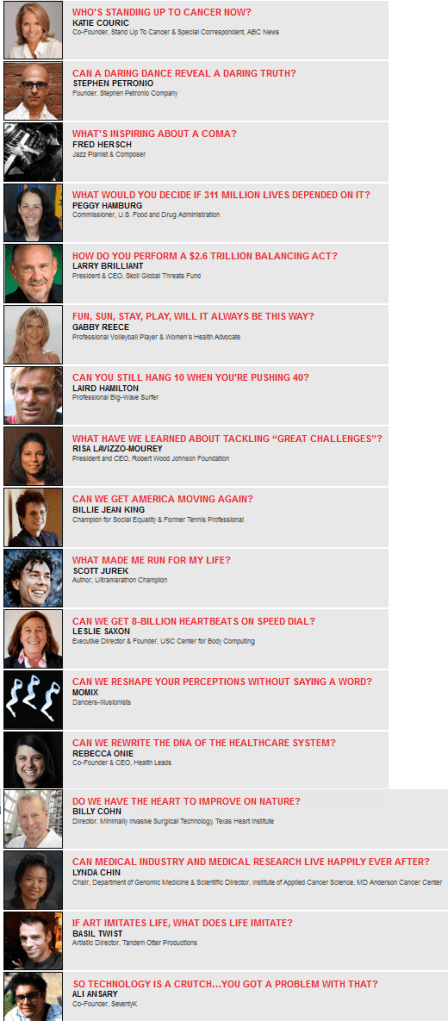
 

New Speakers Announced for TEDMEDLive

New speakers. New twists on what we think we know about healthcare and our healthcare challenges.

  • Katie Couric on cancer.
  • Billie Jean King on getting America moving.
  • Momix dancers/illusionists on reshaping our perceptions. IXperience the IXceptional!
  • Leslie Saxon of the USC Center for Body Computing on whether we can get 8-billion heartbeats on speed dial.
  • And many more.

Have a look. TEDMEDLive @ UTHSC is going to be great!

TEDMED’s Great Challenges Program

What are the Great Challenges of health and medicine, asks Jay Walker, the curator of TEDMED. While there are hundreds, TEDMED has worked with leading health institutes, think tanks, foundations, and individual experts to identify 50 of the most pressing Great Challenges.

With the sponsorship of the Robert Wood Johnson Foundation, TEDMED is hosting the Great Challenges Program

because our community is dedicated to sharing cutting-edge ideas and unusual perspectives. TEDMED believes that before America can effectively address its most complex and persistent health issues, we need a broader, richer understanding of these Challenges. Accordingly, the mission of the Great Challenges Program is not to “solve” America’s most confounding health and wellness problems. Instead we seek to provide America and the world with a comprehensive view, incorporating multiple perspectives, that can set the stage for truly effective action.

Delegates and attendees at the local site for TEDMED (The Kennedy Center) as well as those at the remote simulcast sites (like The University of Tennessee Health Science Center), will be able to learn about the 50 proposed Great Challenges and vote for the 20 final Great Challenges.

What is an example of a Great Challenge? Let’s look at Great Challenge #13: Setting R&D Priorities and Allocating Resources. From the TEDMED Great Challenges Overview:

Churchill described democracy as “the worst form of government, except for all the others.” Our current system of allocating government funds for medical R&D priorities is strongly influenced by political factors at times, and is constantly criticized from all sides. Are there better systems to rank medical R&D priorities and if so, what are they and how can they be integrated into America’s public allocation system?

Visit TEDMED’s Great Challenges website to read more about these challenges and to download an overview of the top 50 Great Challenges.

What’s YOUR idea of a Great Challenge of health and medicine?

Team 6 of the MIFA/UTHSC Healthcare Challenge – CHIPS

The CHIPS Team is composed of medicine, dentistry, and pharmacy students. The team’s advisor is Dr. Melody Cunningham.

CHIPS: Community Health Initiative Program for Seniors.

The target population is senior companions working with MIFA, even though the team hopes that the MIFA clients will experience a secondary benefit. Components of CHIPS include:

  • quarterly newsletter (contributors to include students, community leaders and content would include Q&A section, community resource guide, mental exercises, pictograms)
  • intensive training on social, emotional, and physical aspects
  • advisory board to guide the program

It was noted by the judges that NONE of the team members were born in the 1970s when the show “CHIPS” was running! Thank you, team and judges, for the engaging discussion about your project at the end of your presentation!

5th team – Team POMP – MIFA/UTHSC Healthcare Challenge 2012

Team members of Team POMP were from medicine, pharmacy, graduate health sciences, occupational therapy. Their faculty advisor was Dr. Stuart Caplan. On the title slide is the saying: Leaves are supposed to fall. People aren’t.

The goals of Team POMP’s proposal were to address fall prevention and home safety. The team recommended a fall prevention seminar for the senior companions. The information from the seminar would provide the senior companion with information beneficial to them as well as to the clients that the senior companions serve.

Judges talked about the opportunities for this program to fit in with the existing MIFA programs. All the teams had great interactions with the judges – it was so great that the judges, students, and advisors gave up some of their Saturday for this worthwhile program!

Team 4 of the MIFA/UTHSC Healthcare Challenge 2012

ICE (In Case of Emergency): Personal Health Records

Team members composed of nursing, pharmacy, and medical students. Drs. Steve Nace and Linda Pifer were the team advisors.

The team is interested in addressing the issue of polypharmacy, which is an issue common to an older adult population, such as MIFA’s Senior Companions. The team touched on health literacy, poor patient-provider communication, and health records. Their program objectives were to provide medication reconciliation, improve functional health literacy, and create an ICE Folder.

The team’s logo was a UT along with the green person portion of the MIFA logo, with the words surrounding the icons of Uniting Communities, Education, Research, Clinical Care, Public Service. Clever idea.

The team described horizontal and vertical sustainability and laid out a timeline. They clarified some of the obstacles and answers that were important to address in initiating such a program.

The judges raised some good questions that team members answered quite well.

Team 3 of the day – CHIC – UTHSC/MIFA Health Care Challenge 2012

Team CHICCollaborative Health, Interprofessional Care

Team members are from medicine, dentistry, pharmacy. Faculty advisors were Drs. Chris Peters and Chastity Shelton. The students met with some seniors in the community and obtained information from MIFA to identify their focus. Ultimately, they decided to focus on the social determinants of health. The project’s purpose is to provide a broad foundation in healthcare education and to increase medical literacy and provide a forum for discussion. A goal is to have the MIFA senior companions share the knowledge they gain with their clients. A variety of class topics were identified. The plan is to have each college at UTHSC involved, with each college taking the lead on 2 classes.

The students conducted a brief “class” – including a pretest, brief session on nutrition, and a posttest. The team had a focus on a “win-win” with MIFA senior companions learning more to improve their health, as well as learning content to help improve the health of their clients!

The judges discussed the importance of the social aspect of the team’s proposal and noted that the team’s presentation showed their sensitivity to the senior companions. “It’s not about winning … it’s about making a positive change.

Team 2 – UTHSC Health Care Challenge 2012 – PASS

PASS = Promoting an Alliance of Students and Seniors

Dr. Stokes and Rosemary Batorski were the faculty advisors of this team that has medical, dentistry, and pharmacy students.

The team’s overall goal is to engage senior companions with students to improve quality of life. MIFA was recognized as being uniquely able to assist with social and financial difficulties, with UTHSC being uniquely qualified to contribute to senior companions’ healthcare.

The purpose of the team is to become health advocates for senior companions. Interdisciplinary teams of UTHSC students will work together with senior companions (one team per one senior companion) to either have a friendly relationship with students or to partner together to overcome healthcare barriers. Proposal to meet quarterly after an initial baseline assessment as the companion enters the program.

The main goal of PASS is to keep the companion engaged as a companion to serve MIFA clients. The team described potential benefits to MIFA companions as well as to the students – both interdisciplinary and intradisciplinary benefits. The team has reached out to the Christian Mobile Dental Clinic and have considered partnering with students in the Southern College of Optometry to further integrate healthcare.

Great quote by Oscar Wilde to end the presentation: The only thing to do with good advice is to PASS it on. It is never of any use to oneself.

Great judge questions and comments about literacy levels, companions feeling “overwhelmed” with a large number of students, team makeup to reflect diversity.

Team 1 of UTHSC’s Health Care Challenge 2012

Project SAFE – 1st team to present – Dr. Leslie McKeon (faculty advisor) – team members from medicine, dentistry, pharmacy

Discussed the importance of treating periodontitis for senior companions – aim to reach 80% of senior companions.

Recommendations: A 4-step project called STEM (screen, treat, evaluate, monitor)

In the screening step, would also provide education on prevention, symptoms, proper brushing habits & techniques. Want to reinforce proper behaviors that MIFA senior companions already do, along with informing them about new behaviors that could be helpful to introduce.

Christian Mobile Dental Clinic – the UT College of Dentistry already has an agreement with the CMDC, a project of Bellevue Baptist Church, in place for students to practice in an outreach setting. There is already an agreement in place between the Christian Mobile Dental Clinic, UT College of Dentistry, and the Dental Hygiene program in the College of Allied Health Sciences.

Resources needed include: students, faculty, toothpaste/toothbrushes/floss, fluoride treatment, personal protective equipment (PPE), BP cuffs, flashlights, mobile dental clinic.

Thanks to the judges who were very engaged in the presentation and who asked some excellent questions.